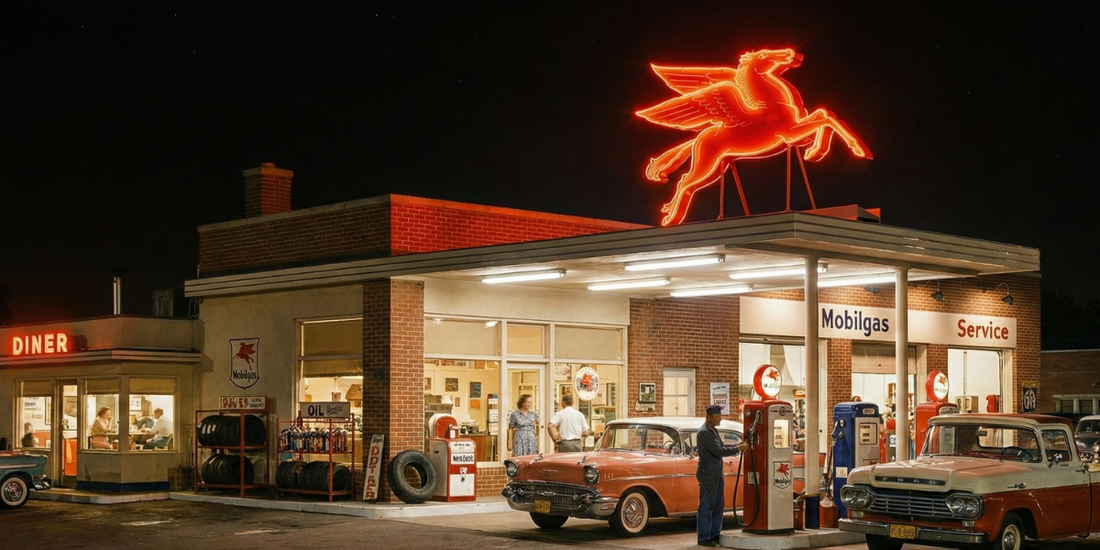
Most real vintage neon signs rely on shape containment—round cans, rectangles, or shields that frame the artwork. The die-cut Pegasus does the opposite.
It removes the frame entirely.
By following the exact silhouette of the Pegasus itself—wings extended, legs mid-stride—the sign becomes sculptural. There’s no border to soften the image, no background to dilute the impact. What you see is pure iconography.
This is why die-cut Pegasus neons were:
- More expensive to produce
- More technically challenging to build
- Less common than standard round Mobil signs
And it’s also why they command attention today in ways few signs can.